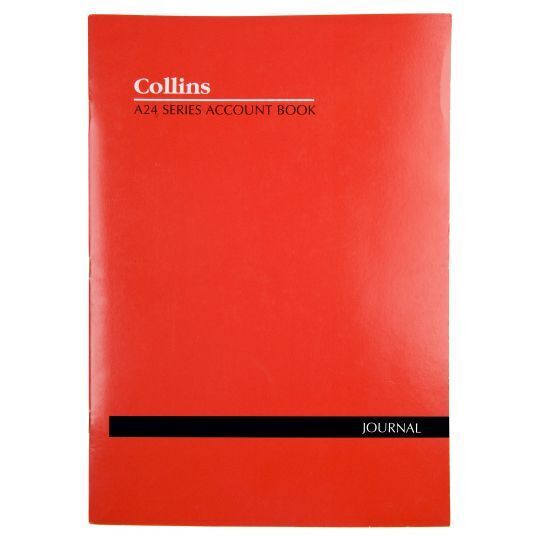
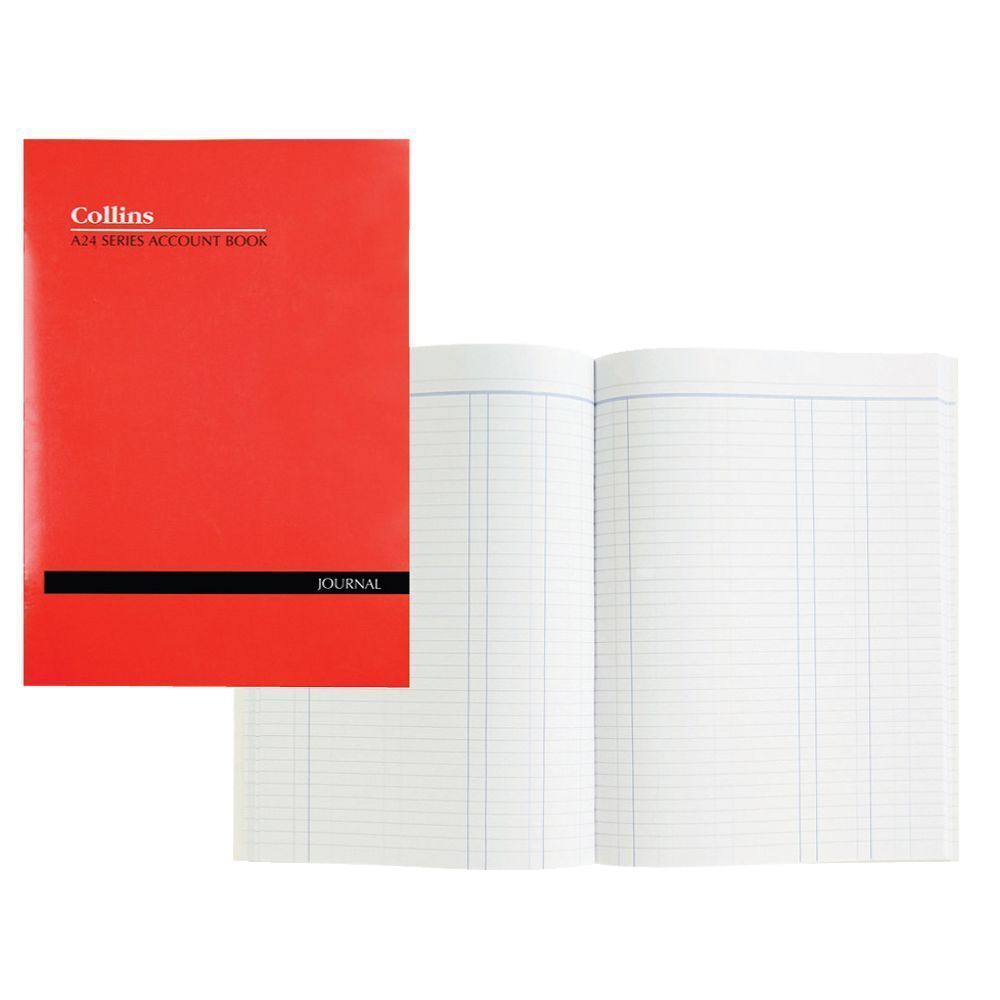
Collins A24 A4 Series Analysis Book Journal - 10202
Calculate Shipping
Express Shipping - $24.99 (ETA: 4 days)
Regular Shipping - $15.00 (ETA: 6 days)
Collins A24 A4 Series Analysis Book Journal - 10202
The Collins A24 A4 Series Analysis Book Journal is the General Journal format in the Collins A24 range — the double-entry bookkeeping record for transactions requiring simultaneous debit and credit entries, together with a narration explaining the transaction. The Journal is the book of prime entry for all transactions that cannot be recorded through specialised day books: adjusting entries, depreciation, accruals, prepayments, bad debt write-offs, corrections, opening and closing entries, and non-cash transactions. In a simple single-book system, the Journal serves as the sole book of prime entry for all transactions before posting to the general ledger.
WHAT A JOURNAL IS AND HOW IT WORKS
- Double-entry format — every entry records both the debit and credit accounts simultaneously; total debits always equal total credits; this dual-entry structure makes the general ledger balance a provable arithmetic identity
- Narration — every entry includes a written explanation of the transaction: what it is, what document supports it, and why it is recorded as it is; the narration connects the supporting document to the ledger account
- Folio reference — the Journal records the ledger account number for each debit and credit; allows every entry to be traced from Journal to ledger and back; the foundation of the double-entry audit trail
- Source document for the ledger — no entry should appear in the general ledger without first passing through the Journal or another book of prime entry; if a ledger account is questioned, the Journal entry is the source and the ledger posting is the consequence
- Difference from the Day Book — the Day Book records transactions chronologically (date, description, amount); the Journal records them in double-entry format (debit account, credit account, narration); in a full system both are used; the Journal handles non-routine entries requiring double-entry explanation
END-OF-PERIOD ADJUSTING ENTRIES — THE PRIMARY USE
- Depreciation — Dr Depreciation Expense / Cr Accumulated Depreciation; recorded at period end for each asset class; ATO requires depreciation schedules; a non-cash adjustment with no associated payment
- Accrued expenses — expenses incurred but not yet paid or invoiced; Dr Expense Account / Cr Accrued Expenses Payable; common: wages accrued, interest accrued, utility bills estimated
- Prepaid expenses — expenses paid in advance of the period they relate to; Dr Prepaid Expenses (asset) / Cr Expense Account; reversed at the start of the next period; common: insurance premiums, subscriptions, rent in advance
- Accrued income — income earned but not yet received or invoiced; Dr Accrued Income (asset) / Cr Income Account; common: term deposit interest, royalties, services rendered but not yet billed
- Deferred income — payment received before service or goods delivered; Dr Bank / Cr Deferred Income (liability); released to income as obligations are fulfilled in subsequent periods
- Provision for doubtful debts — Dr Bad and Doubtful Debts Expense / Cr Provision for Doubtful Debts; estimated uncollectable debtors at period end; further Journal entry writes off confirmed bad debts
- Stock adjustments — Dr/Cr Stock Adjustment and Inventory when physical stock-take differs from recorded value; Journal narration references the stock-take count sheet
OPENING, CLOSING AND CORRECTION ENTRIES
- Opening entries — records the opening balances when new books are commenced; each asset debited, each liability and equity credited; must agree with the previous period's closing trial balance
- Closing entries — at year end, closes all income and expense accounts to Profit and Loss, then closes P&L to Retained Earnings or Capital; resets income and expense accounts to zero for the new financial year
- Correction of errors — records the correction when a wrong amount, wrong account, omission or duplication is discovered; narration explains the original error and the correction; ATO and auditors expect corrections through Journal entries, not erasure
- Reversing entries — mirror image of accrual entries, dated the first day of the new period; prevents double-counting when the actual invoice is received in the subsequent period
OTHER APPLICATIONS
- Payroll journals — compound entry: Dr Wages Expense (gross) / Cr PAYG Withholding Payable / Cr Super Payable / Cr Net Wages Payable (or Bank); further entries when PAYG is remitted and super paid
- GST and BAS adjustments — adjusting GST clearing accounts after credit notes, BAS amendments or corrections; Journal records the net BAS settlement amount payable to or receivable from the ATO
- Asset purchases and disposals — Dr Fixed Asset / Cr Bank (or Cr Loan) on purchase; complex disposal entry removes asset and accumulated depreciation and records profit or loss on disposal
- Loans and financing — recording drawdowns, principal repayments, and interest accruals; the loan lifecycle from inception through repayment
- Trust distributions and SMSF entries — member contributions, pension payments, investment transactions and trust distributions; SMSF auditor reviews Journal entries annually
- Owner's drawings and capital contributions — Dr Drawings / Cr Bank; Dr Bank / Cr Capital; year-end closure of drawings to capital account
- Inter-entity and intercompany transactions — identifying both entities, the nature of the transaction and the basis for the intercompany pricing; elimination entries in consolidated accounts
THE A24 RANGE AT EZYSHOP
- Feint Ruled (10200) — plain lined pages; free-form record-keeping
- Day (10201) — chronological daily transactions; book of prime entry
- Journal (10202 — this product) — double-entry general journal; adjusting entries, depreciation, accruals, corrections
- 4 Money Column (10204) — petty cash, GST, wages, expense categories
- 10 Money Column (10210) — payroll, BAS, petty cash with 10 types, departmental costs
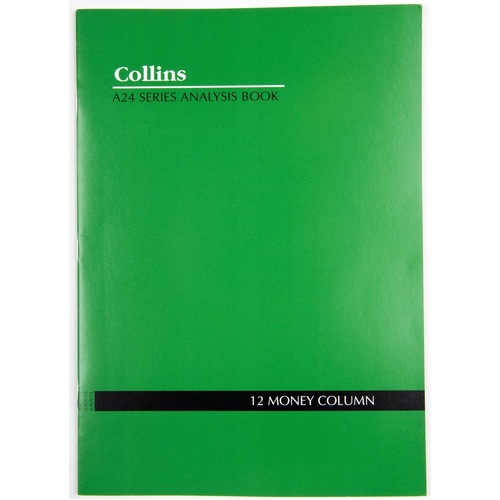
- 12 Money Column (10212) — annual monthly analysis (12 months = 12 columns)
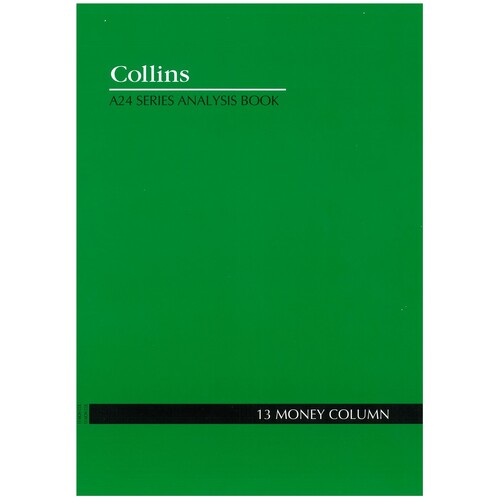
- 13 Money Column (10213) — weekly quarterly (13 weeks = 1 quarter); 12 months plus annual total
- 14 Money Column (10214) — 12 months plus 2 summary columns; quarterly budget monitoring
- 18 Money Column (10218) — six-quarter budgets; 18-month planning
- Minute Book (10232) — formal meeting minutes
SPECIFICATIONS
- Brand: Collins | Range: A24 | SKU: 10202
- Type: Analysis Book — Journal (General Journal / double-entry journal)
- Size: A4
- Application: Adjusting entries, depreciation, accruals, prepayments, corrections, opening/closing entries, payroll journals, GST adjustments, asset transactions, SMSF journals
EzyShop Online — Ships Australia-wide via Australia Post.
(ACB02024)
| SKU | ACB02024 |
| Model # | 10202 |
| Barcode # | 9312136102024 |
| Brand | Collins |
| Unit Of Measure | ea |
| Type | A24 A4 Series Analysis Book |
| Format | Journal |
Be The First To Review This Product!
Help other Ezy Shop Online users shop smarter by writing reviews for products you have purchased.